The flawed Gregorian calendar
contents 04
The calendar you use every day is wrong. Not a little wrong, really wrong. Why the Gregorian calendar drifts from reality, and the thousand-year-old Persian calendar that got it right.
Let me tell you something weird. The calendar you use every day, the one that decides your birthdays, school years, holidays, is actually wrong. Not just a little wrong. Really wrong. It doesn’t match up with the Earth’s seasons properly. Over time, it shifts, drifts, and honestly, it’s one of the worst ways to track time.
I’m Jafran. Software engineer by trade, but my real passion is astronomy and quantum physics. I’ve spent years digging into how we measure time. Let me show you why the Gregorian calendar is broken, how it slowly shifts the seasons, and why there’s a better one already sitting in the wings, mostly forgotten.
01 · A timekeeping disaster hidden in plain sight

Back in 1582, Pope Gregory XIII decided the calendar needed a “fix.” Before that, people used the Julian calendar, which had its own issues. But instead of truly fixing the problem, the church just patched it. That patch is what we still use today. It doesn’t line up with nature, and it never really did.
02 · The Gregorian calendar is a broken system
Seasons are slipping away
A year isn’t exactly 365 days. It’s 365.242198 days. The Gregorian calendar rounds that up to 365.2425 days. That tiny mismatch means seasons slowly shift over time.
- Spring, summer, autumn, and winter all creep forward in the calendar.
- In 10,000 years, summer will start noticeably earlier than it does now.
- The leap year system (an extra day every 4 years, except every 100th year, except every 400th year) is a band-aid. It doesn’t really fix the issue.
Earth’s orbit isn’t a perfect circle
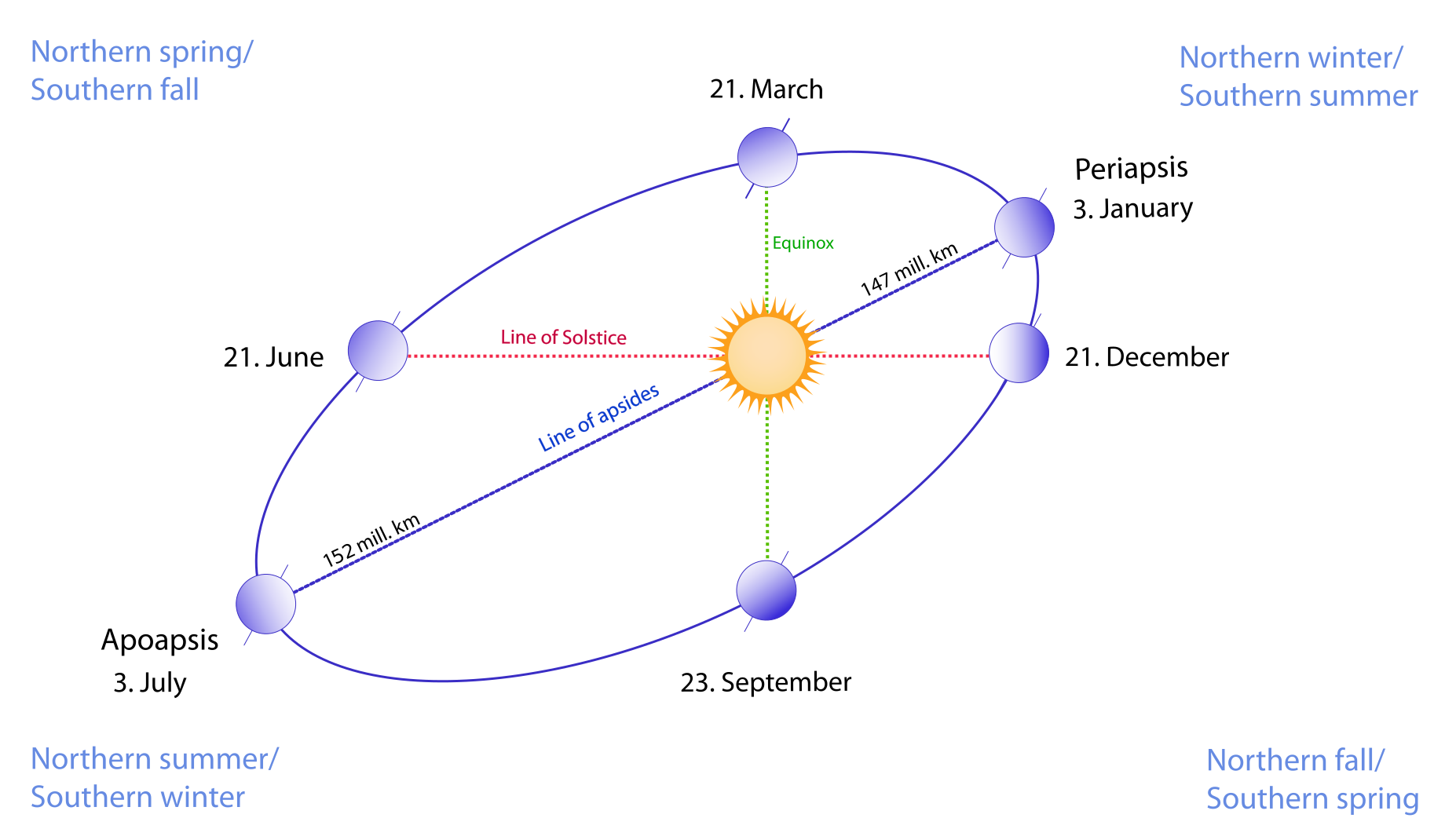
The Gregorian calendar assumes time is simple. Earth doesn’t move in a perfect circle, it moves in an ellipse. That changes everything.
The seasons aren’t all the same length:
- Spring: 92.8 days
- Summer: 93.6 days
- Autumn: 89.8 days
- Winter: 88.9 days
The calendar ignores this. It forces months into artificial lengths instead of following real astronomy.
Leap years are a messy fix
The leap year rule is supposed to fix the drifting problem, but it’s still off. Even with leap years, the Gregorian calendar drifts by one day every 3,226 years. If we left it alone forever, winter could start in August someday. That’s how bad it is.
03 · A better alternative: the Jalali calendar

Here’s where it gets interesting. The West may have messed up their calendar, but a far more accurate one already exists. It’s called the Jalali calendar, introduced in 1079 by the Persian mathematician Omar Khayyam.
Perfectly aligned with the spring equinox
Unlike the Gregorian calendar, Jalali actually follows nature. The new year starts exactly when the spring equinox happens (March 20 or 21). That means the seasons never shift.
No need for constant fixes
Instead of rough leap year rules, Jalali adjusts based on real astronomical observation. It needs just one tiny correction every 2.5 million years. That’s far more accurate than adding an extra day every few centuries the way the Gregorian system does.
The most precise calendar ever made, yet ignored
The Jalali calendar is the most accurate one ever built. But was it adopted worldwide? No. Probably because it came from a Muslim scientist. Instead of admitting it was better, the West stuck to their broken system and exported it to the rest of the world.
04 · So why are we still using it?
Next time you glance at a calendar, ask yourself: why are we still using something so flawed? Maybe it’s time to question what we’ve been told.
∎ thanks for reading. the rest of the archive is here.